How to Plan a Hawai'i Island Vacation
The short answer
Give it seven days. Fly into Kona. Rent a car. Pick one base on the Kohala Coast. Then plan two or three big excursions across the week rather than trying to see everything, because this island is bigger than every other Hawaiian island put together and the drives are real.
If you are still weighing this island against Maui or Kaua’i, start with what Hawai’i Island is actually like and come back here once you have decided.
When to go
Hawai’i Island has no genuinely bad month, which makes this an easier decision than it looks. The leeward Kohala Coast, where you will be staying, is dry and sunny year round. What changes is the water, the whales, and the price.
| Window | What it is good for | Worth knowing |
|---|---|---|
| November to December | Whales begin arriving, quiet before the holidays | Rates climb sharply over Christmas and New Year |
| January to March | Peak whale season, biggest winter surf | The busiest stretch of the year, book early |
| April to May | Warm, drying out, thinner crowds | Spring break weeks are the exception |
| June to August | Driest and warmest, calmest water for snorkeling | Family travel season, so plan activities ahead |
| September to October | Best value, warm water, very quiet beaches | The tail of hurricane season, rarely a factor but worth watching |
Two things pull people toward winter. The humpbacks are in the channel off this coast from November through April with the peak from January through March, and you can watch them from shore rather than from a boat. Our page on whale season on the Kohala Coast covers where to stand and when. The other is that winter surf makes the coastline dramatic, though it also makes some beaches less swimmable.
Summer trades that for the calmest, clearest water of the year, which matters if snorkeling or the manta ray dive is high on your list.
Whenever you come, it is worth checking what is happening in Waikoloa around your dates. A canoe regatta or a festival weekend is the kind of thing that turns a good trip into a memorable one.
How many days do you need
The honest answer depends on how much of the island you want, and the mistake is almost always underestimating the distances.
Five days. Enough for the coast plus one major day trip. Spend the first days close to home on the beaches and the reef, then give one full day to either Hawai’i Volcanoes National Park or the Kohala north loop.
Seven days. The sweet spot, and what we would book ourselves. A week absorbs the beaches, a day on the water, the volcano, a Mauna Kea evening, and a slow day doing nothing, without a single rushed morning.
Ten days or more. Now the Hilo side opens up properly. You can give the waterfalls and the rainforest their own overnight instead of a punishing round trip, and still have days left to do nothing.
Under four days. Stay close. The beaches, the reef, and the manta rays are within half an hour of the resort and they are the things people fly back for. A short trip spent driving is a short trip wasted.
Pick one base
There is a strong temptation, on an island this size, to book two or three nights in three different places and work your way around.
Packing and unpacking eats a half day each time. Check-in and check-out hours cut into the good part of the day. And the practical reality is that the far side of the island has one genuinely rewarding overnight in it, not three. Base yourself once, drive out, come home.
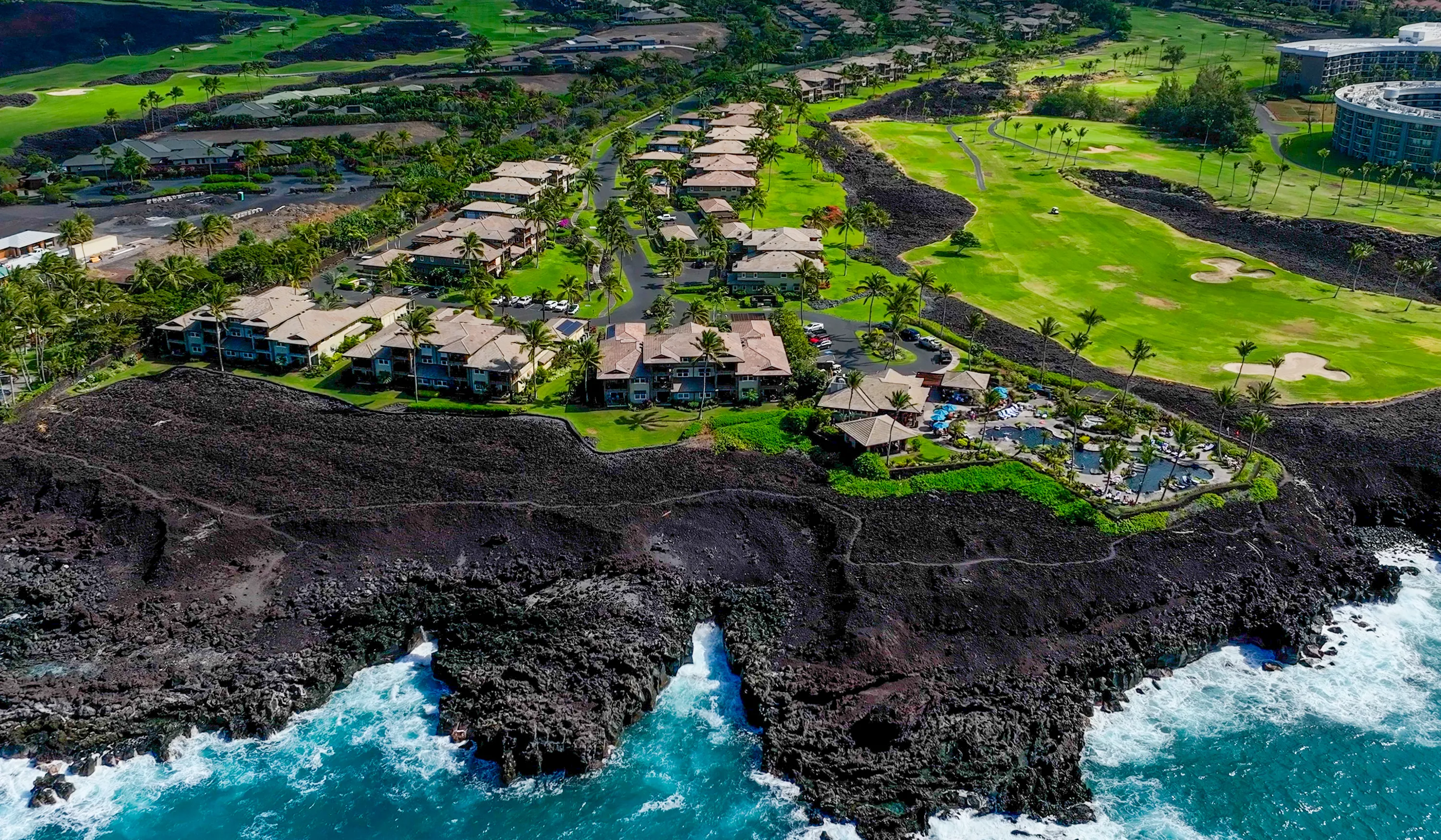
The Kohala Coast is the consensus choice for good reason: the dry side, the best swimming beaches, half an hour from the airport, and far enough north to reach both Volcanoes and the Kohala loop without either becoming unreasonable. Waikoloa Beach Resort sits at the middle of that stretch, and Hali’i Kai is the gated oceanfront community at the north end of it.
The second decision is what kind of roof you want. On an island where you will cook at least some meals and where families need more than one room, a condo and a hotel produce meaningfully different weeks. We laid out that comparison honestly, including what condos usually get wrong, in condo or hotel on the Big Island. If you want the specific case for this community, we also wrote an honest review of Hali’i Kai, trade-offs included, and our suites are here.
Getting here
Fly into Kona International Airport (KOA) unless you have a specific reason not to. It is on the west side, roughly half an hour south of Waikoloa, and it is one of the more pleasant airports anywhere: mostly open-air, and you walk off the plane into the actual climate rather than a jet bridge.
Hilo (ITO) sits on the wet east side. It makes sense if you are basing yourself over there, and almost never otherwise. Flying into Hilo for a Kohala Coast stay adds a two hour cross-island drive to the end of a long travel day.
Most mainland visitors connect through Honolulu or take one of the direct flights from the west coast. Either way, the drive north from KOA is short and straightforward, and we walk through it turn by turn in Kona airport to Waikoloa.
The rental car question
Rent one! Pick it up at the airport or nearby.
There is no meaningful public transit connecting the places you came here to see, and the island is far too spread out to rely on rideshare, which thins out quickly once you leave Kona. Every day trip in this guide assumes a car.
The exception is the resort itself. Once you are settled at Hali’i Kai you can spend a day or two entirely on foot, since the beach, the petroglyph preserve, and both marketplaces are walkable (if you enjoy walking). Some couples on short stays skip the car for part of the week. We worked through when that is realistic in do you need a car in Waikoloa.
One practical note: a standard rental is fine for everything most visitors do, including the drive to the Mauna Kea Visitor Information Station at 9,200 feet. The summit road above it requires true four wheel drive with low range, which most rental contracts prohibit outright. That is what the guided summit tours exist for.
Packing for five climates in one week
This is the part of Big Island planning that people get wrong, and it is a direct consequence of the island’s geography. A single day here can run from sea level to 9,000 feet, and the temperature drops roughly three to four degrees for every thousand feet you climb.
For most of the week, standard beach kit: swimsuits, reef-safe sunscreen, a hat, sunglasses, and something light for dinner. Resort dining on this coast is relaxed almost everywhere.
Then add the things people forget:
- A real jacket. Not a windbreaker. If Mauna Kea is on your list at sunset, you want a fleece or a puffer. Guided summit tours supply parkas; the Visitor Station does not.
- Closed shoes and long pants. Essential for Volcanoes National Park, where you will be walking over lava rock that eats sandals, and welcome on the summit.
- A light rain layer. For the Hilo side and for the upslope drive through Waimea, which is often cool and misty when the coast is cloudless.
- Water shoes or reef booties. Useful on the salt-and-pepper and rocky-entry beaches.
- Binoculars, in whale season. Not essential, since the whales are visible from the bluff without them, but they turn a distant spout into a show. Most Hali’i Kai by Polu Resorts vacation rentals with ocean views provide them.
You do not need to pack a week of groceries. Waikoloa has a full supermarket, and we cover what is worth buying on arrival in stocking your condo.
What a trip actually costs
We will not quote you numbers here, because they move. What is more useful is knowing where the money goes on this island, since it is distributed differently than most beach destinations.
Lodging is the largest line, as everywhere. Our current rates and any member savings live on the offers page, and Hali’i Kai’s daily resort fee, which is set by the community association rather than by us, is explained in full on the resort fee page.
The rental car is not optional here, so budget it as a fixed cost rather than an extra. A week of driving on this island covers real distance, so fuel is a genuine line item too.
Activities are where Big Island budgets tend to run over, because the good ones are guided: the manta ray snorkel, a summit tour, a boat morning, a helicopter flight over the volcano. Pick two or three rather than booking everything, and book those early.
Food is the line a condo actually changes. Having a kitchen and a grill means breakfast and a few dinners happen at home for grocery prices, which on a week-long family trip is a meaningful difference rather than a rounding error. It also means you eat well on the nights you do go out, instead of resenting the third resort breakfast.
What a week looks like
The shape that works is simple: start slow and close to home, put the big drives in the middle of the week when you are adjusted to the time change, and leave the last day for the beach and the packing.
Jet lag is on your side for the first two mornings, since most mainland visitors wake before sunrise. Use them on the water. Save the volcano and Mauna Kea for midweek. Keep at least one day with nothing in it.
Rather than repeat the itinerary here, we wrote it out day by day, with honest drive times from the resort, in things to do around Waikoloa. That is the piece to read once your dates are booked, and the full menu of options lives on our activities pages.
Frequently asked questions
When is the best time to visit the Big Island?
There is no bad month, which is genuinely unusual. Winter, November through April, brings the humpback whales and the biggest surf. Late spring through summer is the driest and warmest stretch. The best value and the smallest crowds sit in the shoulder weeks of late April into May and September into October.
How many days do you need on the Big Island?
Seven is the sweet spot. Five works if you stay close and accept one big day trip rather than three. Ten lets you reach the Hilo side and the volcano without turning either into a forced march. Fewer than four days on an island this size means most of your trip is driving.
Should I fly into Kona or Hilo?
Kona International Airport (KOA) for almost every visitor. It is on the dry west side where the resorts and the best swimming beaches are, and it is about half an hour from Waikoloa. Hilo (ITO) makes sense only if you are basing yourself on the east side.
Do I need a rental car on the Big Island?
Yes, if you plan to see the island. There is no practical transit between the sights and the distances are real. Inside a resort community like Hali'i Kai you can comfortably go without one for a day or two.
Should I split my stay between two islands?
On a week-long trip, usually not. Hawai'i Island alone holds more variety than most visitors get through in seven days, and an inter-island hop costs you the better part of two days once you count packing, returning the car, and checking in again. Split stays make more sense on trips of ten days or longer.
How far in advance should I book a Big Island trip?
Aim for three to six months out for winter and spring break travel, when whale season and school holidays overlap. Summer and the autumn shoulder are more forgiving. Book activities with limited daily capacity, the manta ray snorkel and guided Mauna Kea summit tours especially, as soon as your dates are firm.
What should I pack for the Big Island?
Beach kit for most of the week, plus one genuinely warm layer. It can be forty degrees cooler at 9,200 feet on Mauna Kea than it is on the sand that morning. Add closed shoes and long pants if the volcano or the summit is on your list, reef-safe sunscreen, and a light rain layer if you are crossing to the Hilo side.